Genre: Drama
Dramatic commercials: one person, one want, one turn
A dramatic commercial is a short film in which one person wants something, hits an obstacle they can feel, and reaches a turn where the brand quietly belongs. The turn is written first, by a director in Ahmedabad, who then locks a digital cast and directs every close-up on AI engines, keeping only takes where the face reads true. The team edits, grades and mixes by hand. The work here runs from a 34-second episode of Good Men, Bad Habits to TeleClinic's 90-second telemedicine film, made in German.
A claim asks a viewer to believe you. A scene lets them watch someone they recognise and decide for themselves. That is the case for drama: a father holding his sleeping son, a man kneeling in the rain to hold a dog by a grave. Those frames are about people before products. In a dramatic commercial, the person has a problem, and the brand arrives as what eases it.
Drama short film production comes down to a few parts a director actually controls: who the person is, what they want, what blocks them and where the story turns. Then there is the face, and how much it can say without a line. Below, those parts are at work in TeleClinic's telemedicine film and Episode 16 of our own series, Good Men, Bad Habits.
Watch
2 films we made
Tap any film to play it with sound. Every one was written, directed, edited and graded by Filmito.
The five working parts of drama
One person, clearly seen
Drama starts with a single face the audience can read in two seconds: their age, their clothes, the room they are in. In TeleClinic that is a father holding his sleeping son. One image, and no introduction is needed.
A want with stakes
The person must want something concrete: to pay a bill, to keep a promise, to get back to work. A vague want produces a mood piece. A concrete one gives every cut a direction and gives the viewer something to hope for.
An obstacle you can film
The obstacle has to be something a camera can see. "Money is tight" is a claim. A person going quiet over a letter at the kitchen table is a scene. Abstract pain points become drama once they land on someone's body or evening.
The turn, placed late
The turn is the moment the situation changes, and it is where the brand belongs. Put it too early and the rest becomes a demo. In a 60-second cut it usually lands after the midpoint, leaving one quiet beat of relief afterwards.
Faces and silence
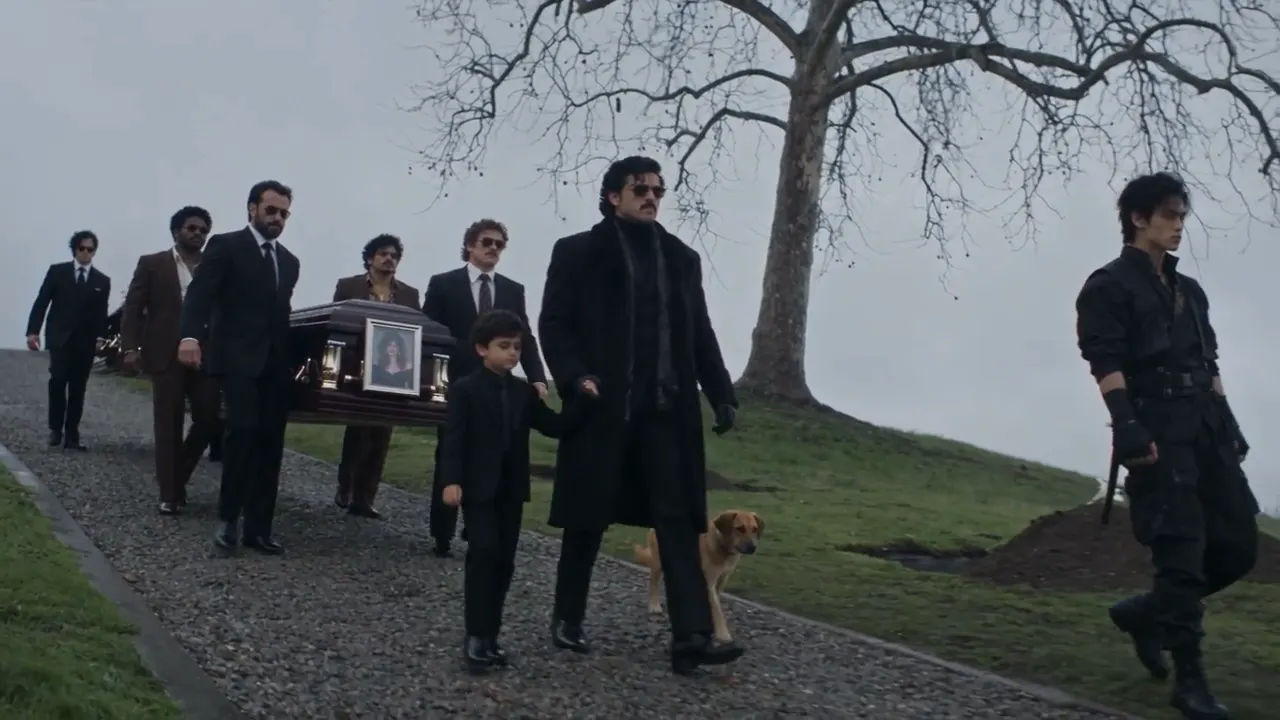
Performance carries drama, not dialogue. Rudra kneeling in the rain to hold a dog by a grave tells the audience what was lost before any line could. Keep the score back until the turn, and it lands as relief rather than instruction.
How a drama film gets made here
Find the person
Before any script, we ask who your customer is on their worst ordinary day. The answer becomes the character, the room and the hour. A brief about features gets rewritten as a brief about someone.
Write the turn first
The script is built backwards from the moment things change. Every earlier scene has to earn that moment, and anything that does not is cut. On-screen titles are planned here but added later, in the edit.
Cast and direct faces
Drama plays out in close-ups, so the cast is locked on character sheets before any scene is made. Each prompt names the expression, and a take where the eyes say the wrong thing is rejected.
Find the pause
Editing, colour grading and the sound mix are done by people. Drama lives in pacing and room tone: how long a pause runs, whether the room is heard before the music. This is where a cut goes from correct to felt.
What a drama film costs
A 30-second drama is $895: room for one person and one turn. At $1,495, a 60-second cut buys time to show the want before the obstacle arrives. Both come with a first cut in 3 days and two revision rounds. A drama that needs more than a minute to unfold moves to AI Film: $2,000 for 2 minutes, $6,000 for 10.
Where drama needs the most care
Digital performances can drift: a smile arrives a frame late, or the eyes lose focus across a long hold. Drama exposes that more than lighter work, because the audience is studying the face. So we cut on the strongest expression and never hold a face longer than its performance can carry. Any shot where the emotion reads false is rejected, and sound and silence carry what a face cannot.
Questions
What people ask about drama films
How long does a short drama film need to be?
Long enough for one turn. Episode 16 of Good Men, Bad Habits moves from a funeral in the rain to a dog following Rudra home in 34 seconds. TeleClinic, a story-led telemedicine film, takes 90. At 30 seconds, plan for a single turn and cut whatever does not serve it.
Can a dramatic commercial work without any dialogue?
Often it works better. Faces, hands and the space around a person carry more than lines that explain feelings. When a voiceover or spoken line is used, it lands best after the image has already done the work. In TeleClinic, a father holding his sleeping son says more about care than any sentence about telemedicine could.
How do you keep a face consistent through a long close-up?
Every character is locked before production from reference photos and character sheets that show the face from several angles and in costume. Each shot prompt names that locked cast. Shots where the face drifts are rejected rather than patched later, because in a drama the audience notices a changed jaw or eye line within a second.
Who plays Rudra in the drama series Good Men, Bad Habits?
Filmito's director and founder plays Rudra himself. He is the lead of all sixteen episodes so far, held steady by a locked character sheet. Episode 16 is about grief and loyalty: two coffins carried across a grey cemetery lawn, and Rudra kneeling to hold the dog sitting by the grave.
Can you make a drama film in German or another language?
Yes. TeleClinic is a 90-second telemedicine ad in German. In a drama the language has to live inside the performance, so every silence is timed to the line as it is actually spoken. Any voice we use is made for that film and that language, never pulled from a library. Filmito works with clients in 50+ countries.
What does an emotional brand film cost compared with a 30-second ad?
The 30-second ad at $895 suits a single scene. A 60-second finished ad at $1,495 gives the want time to build before the turn. Once a story needs more room, it moves to AI Film: $2,000 for 2 minutes and $6,000 for 10. A 60-minute feature is $36,000.
Filmito
Who is your customer on a hard day?
Tell us who they are and what weighs on them. We will find the drama in it and reply with a quote.
Since 2017 · 9,700+ films · 4.8 from 970+ reviews on Fiverr